Fossil FAQ


Q: How are Fossils formed

A: The most common way is for the original shell or bone to be buried in sediment, as even the hardest parts will be broken down if they are exposed to the weather, bacterial action and of course scavengers. The faster the creature or plant is buried after death the greater the chances of preservation. When filled with sediment and prevailing minerals the external imprint is maintained and over time turn into completely different material. Often the ingress of minerals will provide an additional beauty such as the lustre of Pyrite, Opaline and Silica. Peat bogs and Tar pits may preserve whole vertebrae.

For fossil fish see Q: What is Fossil Lake, for wood see Q: How is wood turned to stone.

Q: What makes the prices of Ammonites (and all items) vary so widely?


A: There are several factors and many apply to all the rocks fossils and minerals. Rarity is an obvious differential but relative quality and condition are very important factors and the aspect of what makes something of "better" quality will vary in each particular subject. In most cases it is a matter simply of appearance but often a particularly special characteristic.

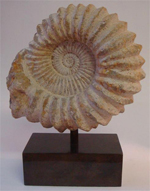
As far as Ammonites are concerned they will vary in quality for several reasons... for example the ones that are from Morocco such as those displayed on the website are extremely well preserved this is due to the climatic differences as the much dryer conditions mean that unlike a similar specimen possibly from the UK they have not suffered the same weathering from acid rain and erosion. There are also many different types of ammonite which will have different characteristics depending on where they came from and the prevailing mineral deposits surrounding the fossilisation.

For example the Craspedites from Russia which are distinctive black and white due to the black calcite which divides the chambers (See stock pic). The slimmer varieties known as Clioniceras, the ridge backed Perisinctus and so on. The detail in fossilisation that has been retained is very important for example the Trilobite will attract a higher price depending on the detail maintained some examples just illustrate an outline and none of the detail of better and rare specimens (See the stock pic for a superb Trilobite head for example).

Whole fish are rare throughout the world as high levels of oxygen in the water will effect the rapid breakdown and decomposition of the fish bones, with the exception of The Green River formation where the three basins of the Colorado river formed an exceptional environment with heavy sediment allowing a wonderful amount of now extinct fish to have been preserved (See fish plaque stock for Knightia and Priscacara)

Fair trade and properly sourced stock is also an indication of price difference, as many specimens are from the some of the poorest regions of the world. The prime finds are usually obtained by reputable companies and the higher prices paid.

Q. What is meant by "Natural Formations"


A. This means that the item has been found in the form it is, quite naturally ( See stock pic of double ammonite and shell formations) It is quite common for collectors to create an artistic arrangement of fossils often to great effect but obviously a man made formation is not the same as finding a naturally occurring one. Hence the perceived value is much higher to carefully extract an original collection, in its entirety.

Q.What is meant by "inclusions"

A. This literally means that the piece has acquired an additional feature in its formation, for example some quartz will clearly show such inclusions of minerals, Black inclusions tend to be Tourmaline rods, Green Azurite and Gold/Rust shades Iron trying to infuse. They make for very interesting specimens.

Q. What is meant by Hydro-Thermal Veins?

A. Many good specimens are obtained from mineral veins. High temperature fluids deposit minerals in cracks and fissures in rocks these are often called hydrothermal veins and are frequently worked as sources of ore, they often contain colourful specimens and good crystals. Sometimes weathered- out cavity linings called Geodes are lined with well-shaped crystals and many fine specimens of Amethyst occur in these. Many crystal formations occur in Hydro- thermal veins. The largest are not always the most spectacular and some of the smallest crystals are the most perfectly formed ones.

Q. What is double terminated Quartz?


A. Most crystals have a single pointed end but in the case of Double terminated this simply means they have a point at both ends. See stock pictures "Double terminated Quartz" one of the pieces is exceptional as it features both a double point and has an amazing inclusion of trapped water!

Q: How does wood turn to stone?

A: When a log or branch from a tree falls, if it is quickly submersed in mud, before the decay that would happen should it be exposed to air and bacteria take hold, then the mineral-rich ground water soaks into the wood or log. This ground water then infiltrates the spaces between the cells of the wood. As the wood breaks down a weak acid is generated and this enables the minerals to move out of the ground water solution and fill the spaces with crystals. This process is called permineralization or petrification, it can occur in a very short space of time geologically speaking, often less than a hundred years but can take much longer and the wood disintegrates further over several thousand years.

The next process occurs as the minerals replace the original wood tissues sometimes as slowly as molecule by molecule. Some parts of the wood, as in the case of the layers of annual rings that grew in the springtime, are the first and most vulnerable to decay and thus become mineralised earlier than the harder portions. This results in the preservation of the distinctive ring patterns you see in a freshly cut tree stump.

The final composition of the petrified wood will then usually become some form of Quartz or Calcite. It will depend upon what minerals are in the ground water. For example a silica solution may often cause a vivid coloured Agate, Jasper or even Opaline species (All from the family of Quartz) The different colours are the results of trace minerals in the solution with Copper, Cobalt and Chromium giving green or blue, Iron giving red (pinkish if not too strong a component),brown or yellow and carbon inevitably black. Occasionally both Agate and Calcite indicate that both Calcium Carbonate and Silica were in the water although not necessarily at the same time. When the wood rots in mud before petrification it can leave a mould behind which if it is filled with crystalline minerals can create a cast and this may preserve all the wonderful bark detail.

Wonderful examples can be seen in the State Petrified Forest in Arizona USA and White Cliffs in Australia.

Q: What is Fossil Lake or The Green River Formation?

A: The Fossil Lake dates to the early Eocene period over 50 million years ago. The water drained from the recently arisen Rocky Mountains created an amazing inter-mountain basin which came to be called Fossil Lake. The climatic conditions in this area were sub-tropical and pretty much the same as that of Florida to-day. This special environment lasted for around 2million years and was home to Palm Trees, Turtles, Crocodiles and an abundance of fish now extinct. It would seem that a variety of unique conditions prevailed to encapsulate some of the best preserved fossils, especially fish, ever discovered.

The rich abundance of fossils in the sediments of the Lake were first discovered in the 1850's close to the town of Green River in Wyoming, hence the name now known as The Green River Formation. Unlike other fossilised forms in the rest of the world, where only fragments of fossilised fish are found, this area is home to some of the most perfectly preserved whole fish species.

Experts in Palaeontology and Sedimentology have theorised that the lake was sufficiently deep that it may have been "Anoxid" or devoid of Oxygen, this would have explained the superb fossilisation as the fish would not have been disturbed by scavengers and this would have been instrumental in preventing the further decomposition of the specimens. As the sedimentary layers contain such an abundance of fish it has been mooted by the scientists that it may have been as a result of a series of events such as Algal blooms that so many fish were killed on such a large scale, as were other plant and animal life which died and sank to the bottom, as in lakes and ponds to this day.

Storms, and rainfall in general, brought down from the Rocky Mountains, a source of mineral rich-water which would ensure their preservation.

© Copyright 2008 Rocks & Fossils Website design by Toolkit Websites